
再 and 又: When an Action Is Repeated
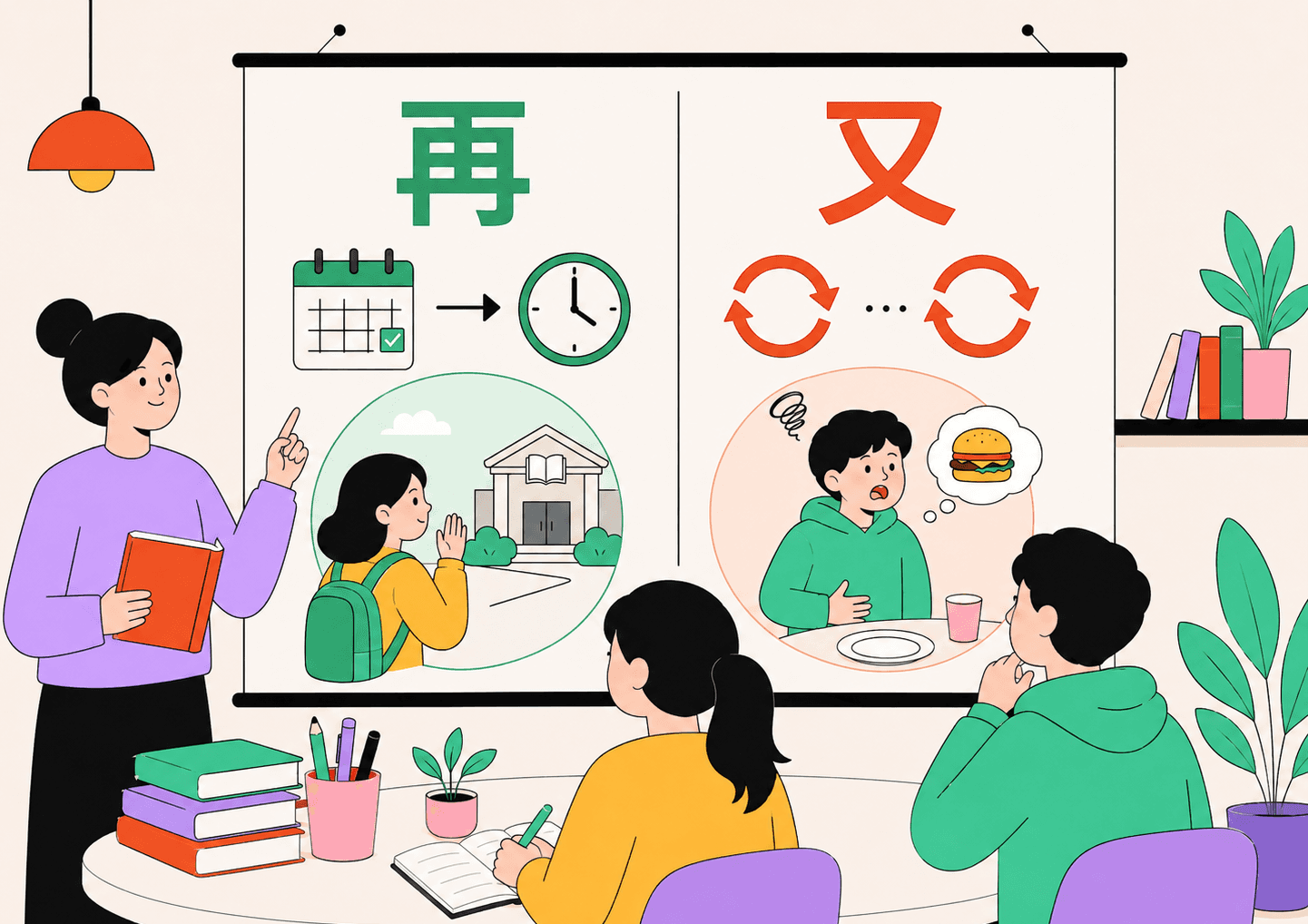
再 zài — “one more time” in the future
再 zài is used when an action will be repeated later. In other words, we are talking about something that has not happened yet, but may happen in the future.
The simplest structure is:
再 + verb
我想再看一遍。
wǒ xiǎng zài kàn yí biàn.
I want to watch it one more time.
请你再说一遍。
qǐng nǐ zài shuō yí biàn.
Please say it one more time.
我明天再来。
wǒ míngtiān zài lái.
I will come again tomorrow / I will stop by tomorrow.
我们下次再见。
wǒmen xià cì zài jiàn.
See you next time.
Here, 再 shows that the action will be repeated later: to watch one more time, say one more time, come tomorrow, meet next time.
再 in requests and suggestions
再 is often used when we ask someone to repeat an action or suggest doing something one more time.
请再读一遍。
qǐng zài dú yí biàn.
Please read it one more time.
你再试试吧。
nǐ zài shìshi ba.
Try one more time.
我们再练习一下。
wǒmen zài liànxí yíxià.
Let’s practice a little more.
你再想想。
nǐ zài xiǎngxiang.
Think about it again.
In such phrases, 再 sounds natural because the action is only going to be performed.
再 with 一次 and 一遍
再 is often used with 一次 yí cì and 一遍 yí biàn. Both can be translated as “one time,” but there is a small difference.
一次 yí cì — once, the fact that an action is performed.
一遍 yí biàn — once from beginning to end, completely.
我想再去一次中国。
wǒ xiǎng zài qù yí cì Zhōngguó.
I want to go to China one more time.
请再说一遍。
qǐng zài shuō yí biàn.
Please repeat it one more time.
我想再看一遍这部电影。
wǒ xiǎng zài kàn yí biàn zhè bù diànyǐng.
I want to watch this movie one more time.
我们再做一次这个练习。
wǒmen zài zuò yí cì zhè ge liànxí.
Let’s do this exercise one more time.
When we are talking about repeating a text, movie, song, or exercise from beginning to end, 一遍 is often a good choice.
又 yòu — “again” in the past
又 yòu is used when an action has already been repeated. In other words, we are talking about a situation that has already happened.
Structure:
又 + verb + 了
他又迟到了。
tā yòu chídào le.
He was late again.
我又忘了。
wǒ yòu wàng le.
I forgot again.
她又买了新衣服。
tā yòu mǎi le xīn yīfu.
She bought new clothes again.
今天又下雨了。
jīntiān yòu xià yǔ le.
It rained again today.
Here, the action has already happened: he was late, I forgot, she bought something, it rained. That is why 又 is used.
又 often has the nuance of “again”
In Russian, the word “опять” can sometimes have a slight nuance of dissatisfaction: “late again,” “forgot again,” “rain again.” In Chinese, 又 can also often sound this way, especially if the situation keeps repeating and the speaker does not really like it.
你又来了!
nǐ yòu lái le!
You came again!
他又没做作业。
tā yòu méi zuò zuòyè.
He didn’t do his homework again.
我又说错了。
wǒ yòu shuō cuò le.
I said it wrong again.
But 又 is not always negative. It can simply show repetition in a neutral way.
我们又见面了。
wǒmen yòu jiànmiàn le.
We met again.
我又学了一个新词。
wǒ yòu xué le yí ge xīn cí.
I learned another new word.
再 and 又: comparing examples
Sometimes the same verb can be used with both 再 and 又, but the meaning will be different.
再去 and 又去了
我想再去中国。
wǒ xiǎng zài qù Zhōngguó.
I want to go to China one more time.
我又去了中国。
wǒ yòu qù le Zhōngguó.
I went to China again.
In the first sentence, the trip has not happened yet. It is a wish or a plan. That is why we use 再.
In the second sentence, the trip has already happened. That is why we use 又.
再看 and 又看了
我想再看一遍。
wǒ xiǎng zài kàn yí biàn.
I want to watch it one more time.
我又看了一遍。
wǒ yòu kàn le yí biàn.
I watched it again once.
再看 — to watch again later.
又看了 — already watched again.
再说 and 又说了
请你再说一遍。
qǐng nǐ zài shuō yí biàn.
Please repeat it one more time.
他又说了一遍。
tā yòu shuō le yí biàn.
He repeated it again.
In the first case, we are asking someone to say it again. The action is still ahead. In the second case, he has already said it again.
The main idea
Both 再 and 又 can be translated as “again,” “one more time,” or “once again,” but in Chinese they are used differently.
再 refers to an action that will be repeated in the future or has not happened yet.
又 refers to an action that has already been repeated.
The main rule for beginners is: if the action is still ahead, use 再. If the action has already happened, use 又.