
Double Ninth Festival in China: What Is 重阳节?
What Is the Double Ninth Festival Called in Chinese?
重阳节
Chóngyáng Jié
Double Ninth Festival / Chongyang Festival
Let’s break the word down:
重
chóng
repeated / double
阳
yáng
yang / the bright, active principle
节
jié
festival / holiday
In traditional Chinese culture, the number 9 is associated with yang — the active, bright principle. When two nines appear together, it becomes 重阳 chóngyáng — “double yang” or “double nine.”
重阳节是中国的传统节日。
Chóngyáng Jié shì Zhōngguó de chuántǒng jiérì.
The Chongyang Festival is a traditional Chinese holiday.
Why Nines?
The festival is celebrated on the ninth day of the ninth lunar month. That is why the idea of the “double ninth” appears in its name. In Chinese tradition, it is an autumn holiday associated with nature, height, longevity, respect for elders, and family values.
There is another important association: in Chinese, the number nine is 九 jiǔ. It sounds similar to 久 jiǔ, which means “long” or “a long time.” That is why the holiday is often connected with wishes for a long life.
九
jiǔ
nine
久
jiǔ
long / a long time
长久
chángjiǔ
long-lasting / lasting for a long time
Example:
九和久发音一样。
Jiǔ hé jiǔ fāyīn yíyàng.
九 and 久 are pronounced the same way.
A Festival of Respect for Elderly People
Today, 重阳节 Chóngyáng Jié is especially connected with respect for elderly people. In China, this day is also seen as a day to care for elders and express gratitude to older relatives. In 1989, the Double Ninth Festival was designated in China as a day for elderly people.
So on this day, people may visit their grandparents, call their parents, spend time with family, give gifts, or simply show attention and care.
Useful words:
老人
lǎorén
elderly person
爷爷
yéye
grandfather on the father’s side
奶奶
nǎinai
grandmother on the father’s side
外公
wàigōng
grandfather on the mother’s side
外婆
wàipó
grandmother on the mother’s side
尊重
zūnzhòng
to respect
照顾
zhàogù
to take care of
我们应该尊重老人。
Wǒmen yīnggāi zūnzhòng lǎorén.
We should respect elderly people.
重阳节的时候,我去看爷爷奶奶。
Chóngyáng Jié de shíhou, wǒ qù kàn yéye nǎinai.
On the Double Ninth Festival, I visit my grandparents.
我给外婆打电话。
Wǒ gěi wàipó dǎ diànhuà.
I call my grandmother on my mother’s side.
The Main Tradition: Climbing to a High Place
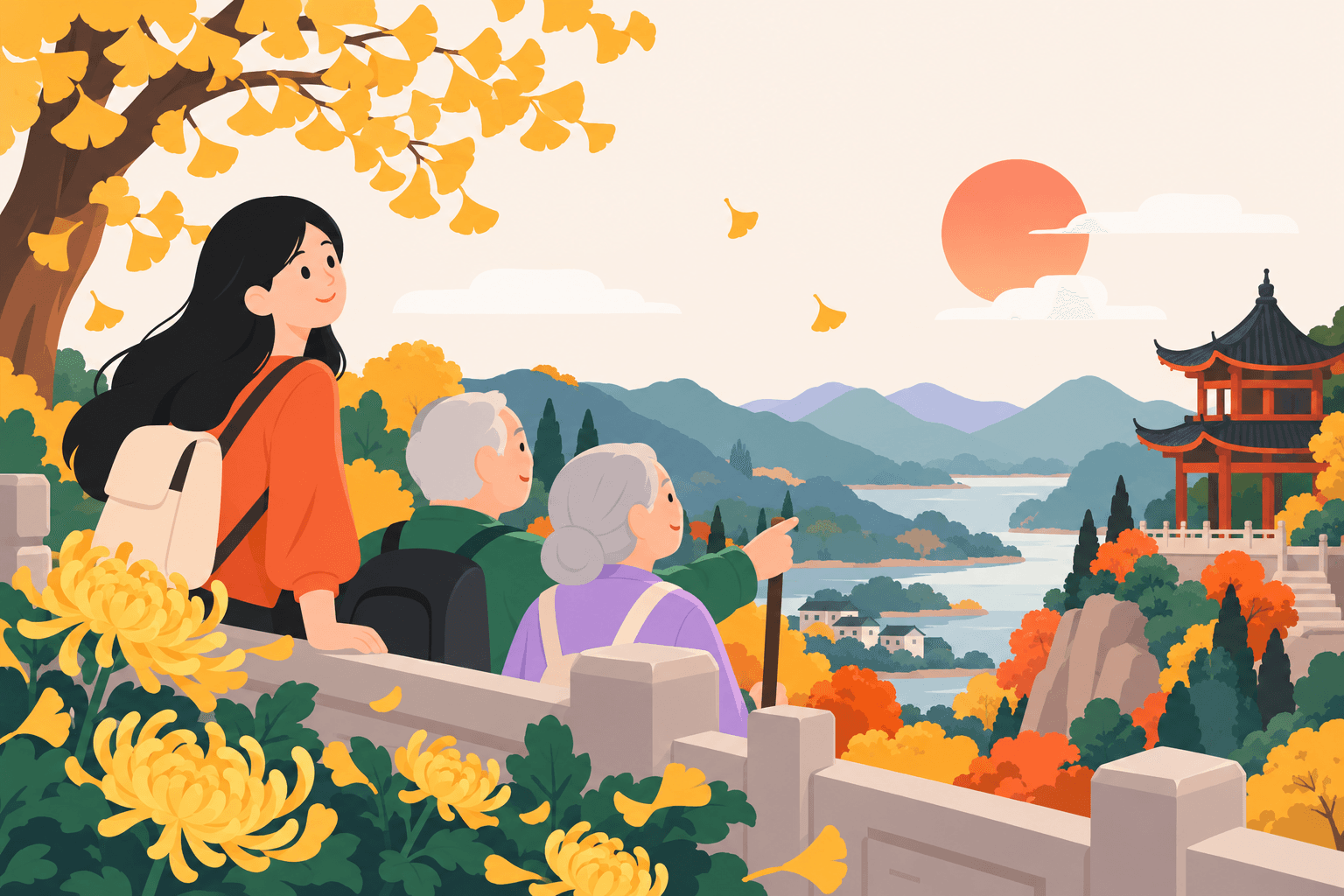
One of the most famous traditions of the festival is 登高 dēnggāo, which means climbing to a high place: a mountain, a hill, a tower, or simply walking somewhere beautiful in nature. This tradition is considered one of the characteristic customs of the Double Ninth Festival.
登高
dēnggāo
to climb to a high place
爬山
pá shān
to climb mountains / to go hiking in the mountains
山
shān
mountain
秋游
qiūyóu
autumn outing / autumn trip
重阳节人们喜欢登高。
Chóngyáng Jié rénmen xǐhuan dēnggāo.
On the Double Ninth Festival, people like climbing to high places.
我们去爬山吧。
Wǒmen qù pá shān ba.
Let’s go hiking in the mountains.
秋天爬山很舒服。
Qiūtiān pá shān hěn shūfu.
Hiking in autumn is very pleasant.
Why climb to a high place? In traditional culture, this was connected with wishes for health, good luck, and protection from misfortune. Today, for many people, it is simply a beautiful autumn custom: to take a walk, breathe fresh air, and enjoy nature.
Chrysanthemums and the Autumn Atmosphere
The Double Ninth Festival falls in autumn, so it is closely connected with chrysanthemums. During this period, people may admire chrysanthemums, drink chrysanthemum wine or tea, and the festival itself is sometimes associated with autumn flowers and longevity.
菊花
júhuā
chrysanthemum
赏菊
shǎng jú
to admire chrysanthemums
菊花茶
júhuā chá
chrysanthemum tea
菊花酒
júhuā jiǔ
chrysanthemum wine
重阳节可以赏菊。
Chóngyáng Jié kěyǐ shǎng jú.
On the Double Ninth Festival, people can admire chrysanthemums.
我喜欢喝菊花茶。
Wǒ xǐhuan hē júhuā chá.
I like drinking chrysanthemum tea.
秋天的菊花很漂亮。
Qiūtiān de júhuā hěn piàoliang.
Autumn chrysanthemums are very beautiful.
What Do People Eat on the Double Ninth Festival?
One of the traditional treats is 重阳糕 chóngyáng gāo, “Chongyang cake” or “Double Ninth cake.” These festive sweets are connected with wishes for health, good luck, and moving upward, because the word 糕 gāo sounds similar to 高 gāo, which means “high.” Eating Double Ninth cake is often mentioned among the customs of the festival.
重阳糕
chóngyáng gāo
Chongyang cake / Double Ninth cake
糕
gāo
cake / pastry / sweet
高
gāo
high / tall
你吃过重阳糕吗?
Nǐ chī guo chóngyáng gāo ma?
Have you ever eaten Chongyang cake?
重阳糕是重阳节的传统食物。
Chóngyáng gāo shì Chóngyáng Jié de chuántǒng shíwù.
Chongyang cake is a traditional food of the Double Ninth Festival.
这个糕很好吃。
Zhè ge gāo hěn hǎochī.
This cake is very tasty.
What Else Do People Do on This Day?
Traditions may differ in different regions, but the following activities are most often associated with the festival:
登高
dēnggāo
to climb to a high place
爬山
pá shān
to go hiking in the mountains
赏菊
shǎng jú
to admire chrysanthemums
喝菊花茶
hē júhuā chá
to drink chrysanthemum tea
吃重阳糕
chī chóngyáng gāo
to eat Chongyang cake
看望老人
kànwàng lǎorén
to visit elderly people
陪家人
péi jiārén
to spend time with family
重阳节我们陪家人。
Chóngyáng Jié wǒmen péi jiārén.
On the Double Ninth Festival, we spend time with family.
他们去看望老人。
Tāmen qù kànwàng lǎorén.
They go to visit elderly people.
我们一起喝菊花茶。
Wǒmen yìqǐ hē júhuā chá.
We drink chrysanthemum tea together.
How to Congratulate Someone on the Double Ninth Festival
Here are a few simple phrases you can use on this day.
重阳节快乐!
Chóngyáng Jié kuàilè!
Happy Double Ninth Festival!
祝你健康长寿!
Zhù nǐ jiànkāng chángshòu!
Wishing you health and longevity!
祝爷爷奶奶身体健康!
Zhù yéye nǎinai shēntǐ jiànkāng!
Wishing Grandma and Grandpa good health!
祝您重阳节快乐!
Zhù nín Chóngyáng Jié kuàilè!
Wishing you a happy Double Ninth Festival!
Note that 您 nín is the polite form of “you.” It is good to use when speaking to elders.
Questions About the Festival in Chinese
重阳节是什么时候?
Chóngyáng Jié shì shénme shíhou?
When is the Double Ninth Festival?
重阳节有什么习俗?
Chóngyáng Jié yǒu shénme xísú?
What customs are there for the Double Ninth Festival?
你们重阳节做什么?
Nǐmen Chóngyáng Jié zuò shénme?
What do you do on the Double Ninth Festival?
你喜欢爬山吗?
Nǐ xǐhuan pá shān ma?
Do you like hiking in the mountains?
你喝过菊花茶吗?
Nǐ hē guo júhuā chá ma?
Have you ever drunk chrysanthemum tea?
你吃过重阳糕吗?
Nǐ chī guo chóngyáng gāo ma?
Have you ever eaten Chongyang cake?
How Is 重阳节 Different from Other Chinese Holidays?
Every Chinese holiday has its own atmosphere.
春节 Chūnjié is Chinese New Year, the main family holiday.
中秋节 Zhōngqiū Jié is the Mid-Autumn Festival, connected with the moon, family unity, and mooncakes.
端午节 Duānwǔ Jié is the Dragon Boat Festival, associated with dragon boat races and zongzi.
重阳节 Chóngyáng Jié is about autumn, mountains, chrysanthemums, longevity, and respect for elders.
In other words, the Double Ninth Festival is calmer and more autumnal. It is not as noisy as Chinese New Year, but it is very important for understanding Chinese culture and attitudes toward family.
重阳节 Chóngyáng Jié is the Double Ninth Festival in China. It is celebrated on the ninth day of the ninth month of the lunar calendar.
The main associations of the festival are autumn, mountains, chrysanthemums, longevity, and respect for elderly people. On this day, people may climb to high places, drink chrysanthemum tea, eat 重阳糕, visit older relatives, and wish them good health.
For Chinese learners, this is a beautiful topic: through it, you can learn vocabulary about holidays, family, autumn, and health, and better understand how respect for elders is expressed in Chinese culture.