
When to Use 是 and When It Is Not Needed
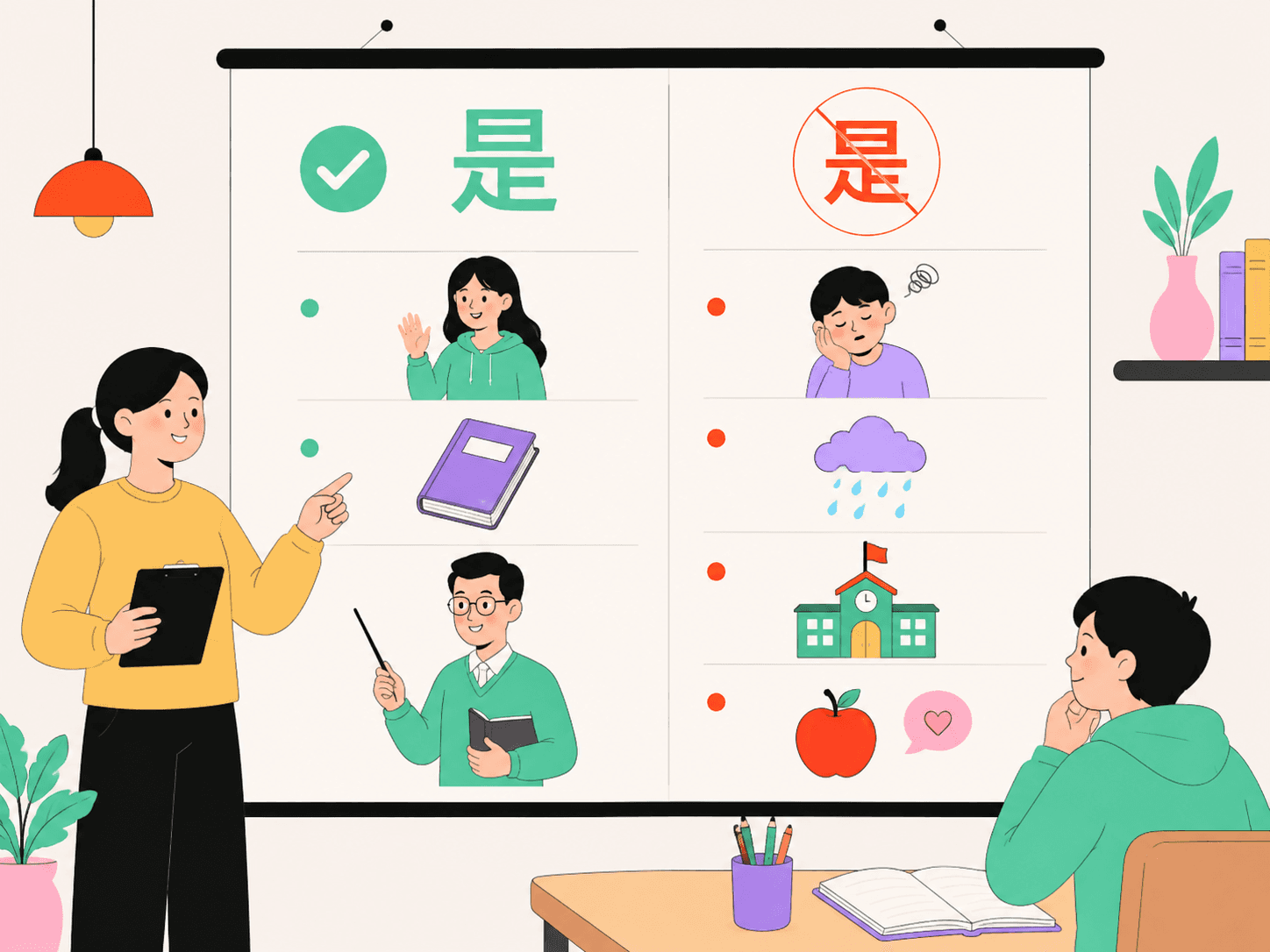
是 shì — when someone or something is someone or something
The main use of 是 is when we say that one object, person, or thing is another object, person, or thing.
Subject + 是 + noun
我是老师。
wǒ shì lǎoshī.
I am a teacher.
他是学生。
tā shì xuésheng.
He is a student.
这是我的书。
zhè shì wǒ de shū.
This is my book.
北京是中国的首都。
Běijīng shì Zhōngguó de shǒudū.
Beijing is the capital of China.
今天是星期五。
jīntiān shì xīngqīwǔ.
Today is Friday.
Here, 是 is followed by a noun or a noun phrase: teacher, student, book, capital, Friday.
是 with profession, status, and role
是 is often used when we talk about a person’s profession, role, status, or belonging to a certain group.
我是学生。
wǒ shì xuésheng.
I am a student.
她是医生。
tā shì yīshēng.
She is a doctor.
他是中国人。
tā shì Zhōngguó rén.
He is Chinese.
我们是朋友。
wǒmen shì péngyou.
We are friends.
他们是老师。
tāmen shì lǎoshī.
They are teachers.
In these sentences, 是 is needed because we are saying who someone is.
是 with the demonstratives 这 and 那
是 is very often used after the words 这 zhè — “this” and 那 nà — “that.”
这是咖啡。
zhè shì kāfēi.
This is coffee.
这是我的手机。
zhè shì wǒ de shǒujī.
This is my phone.
那是你的书吗?
nà shì nǐ de shū ma?
Is that your book?
这是谁?
zhè shì shéi?
Who is this?
这是什么?
zhè shì shénme?
What is this?
These phrases are very useful at the beginner level because they help you ask and explain what is in front of you.
Negation with 是: 不是
If you need to say “is not,” use 不是 bú shì.
Note that 不 bù changes its pronunciation before the fourth tone and is pronounced bú.
Subject + 不是 + noun
我不是老师。
wǒ bú shì lǎoshī.
I am not a teacher.
他不是学生。
tā bú shì xuésheng.
He is not a student.
这不是我的书。
zhè bú shì wǒ de shū.
This is not my book.
今天不是星期五。
jīntiān bú shì xīngqīwǔ.
Today is not Friday.
Questions with 是
To ask a yes-or-no question, you can add the particle 吗 ma at the end of the sentence.
你是学生吗?
nǐ shì xuésheng ma?
Are you a student?
她是医生吗?
tā shì yīshēng ma?
Is she a doctor?
这是你的手机吗?
zhè shì nǐ de shǒujī ma?
Is this your phone?
You can also use the question form 是不是 shì bú shì.
你是不是学生?
nǐ shì bú shì xuésheng?
Are you a student?
这是不是你的书?
zhè shì bú shì nǐ de shū?
Is this your book?
Both forms are correct. The form with 吗 is usually easier for beginners.
When 是 is not needed: with adjectives
One of the most common beginner mistakes is putting 是 before adjectives.
In Chinese, an adjective can function as the predicate by itself. That is why in sentences like “I am busy,” “she is beautiful,” or “it is cold today,” 是 is usually not needed.
Incorrect:
我是忙。
Correct:
我很忙。
wǒ hěn máng.
I am busy.
Incorrect:
她是漂亮。
Correct:
她很漂亮。
tā hěn piàoliang.
She is beautiful.
Incorrect:
天气是冷。
Correct:
天气很冷。
tiānqì hěn lěng.
The weather is cold.
Incorrect:
这个菜是好吃。
Correct:
这个菜很好吃。
zhè ge cài hěn hǎochī.
This dish is tasty.
是 is not needed with action verbs
是 is not placed before ordinary action verbs such as go, eat, drink, study, work, or watch.
Incorrect:
我是学习中文。
Correct:
我学习中文。
wǒ xuéxí Zhōngwén.
I study Chinese.
Incorrect:
他是喝咖啡。
Correct:
他喝咖啡。
tā hē kāfēi.
He drinks coffee.
Incorrect:
我们是去学校。
Correct:
我们去学校。
wǒmen qù xuéxiào.
We are going to school.
In a Chinese sentence, the action verb itself functions as the predicate, so 是 is not needed before it.
是 is not needed in sentences with 有
The verb 有 yǒu means “to have,” “there is,” or “to exist.” 是 is not used with it.
我有手机。
wǒ yǒu shǒujī.
I have a phone.
他有哥哥。
tā yǒu gēge.
He has an older brother.
这里有咖啡。
zhèlǐ yǒu kāfēi.
There is coffee here.
桌子上有一本书。
zhuōzi shàng yǒu yì běn shū.
There is a book on the table.
Incorrect:
我是有手机。
Correct:
我有手机。
wǒ yǒu shǒujī.
I have a phone.
If you need a negative form, use 没有 méi yǒu, not 不有.
我没有手机。
wǒ méi yǒu shǒujī.
I don’t have a phone.
是 is not needed with location
When we say where a person or object is located, we usually use 在 zài, not 是.
我在家。
wǒ zài jiā.
I am at home.
他在学校。
tā zài xuéxiào.
He is at school.
书在桌子上。
shū zài zhuōzi shàng.
The book is on the table.
咖啡在这里。
kāfēi zài zhèlǐ.
The coffee is here.
Incorrect:
我是家。
Correct:
我在家。
wǒ zài jiā.
I am at home.
It is important to distinguish:
我是学生。
wǒ shì xuésheng.
I am a student.
Who am I?
我在学校。
wǒ zài xuéxiào.
I am at school.
Where am I?
是 in the 是……的 construction
At a more advanced level, 是 appears in the 是……的 construction. It is often used when we want to emphasize a detail of an action that has already happened: when, where, with whom, or by what means it happened.
我是昨天来的。
wǒ shì zuótiān lái de.
I came yesterday.
他是在北京学习的。
tā shì zài Běijīng xuéxí de.
He studied in Beijing.
我是坐地铁来的。
wǒ shì zuò dìtiě lái de.
I came by subway.
For beginners, it is important not to confuse this construction with ordinary 是. Here, 是……的 is not simply “to be,” but a way to highlight important information in the sentence.
Comparing where 是 is needed and where it is not
我是老师。
wǒ shì lǎoshī.
I am a teacher.
是 is needed because it is followed by a noun.
我很忙。
wǒ hěn máng.
I am busy.
是 is not needed because we are using an adjective.
他是中国人。
tā shì Zhōngguó rén.
He is Chinese.
是 is needed because we are saying who he is.
他在中国。
tā zài Zhōngguó.
He is in China.
是 is not needed because we are talking about location.
这是咖啡。
zhè shì kāfēi.
This is coffee.
是 is needed because we are explaining what it is.
这个咖啡很好喝。
zhè ge kāfēi hěn hǎohē.
This coffee is tasty.
是 is not needed because we are describing a quality.
The main idea
是 shì is an important word in Chinese, but it does not need to be used in every sentence.
The main rule for beginners is: 是 is used when we say that someone or something is someone or something. Most often, 是 is followed by a noun.
If we describe a quality, we use an adjective without 是: 我很忙, 天气很冷, 这个菜很好吃.
If we talk about an action, possession, or location, we also use other words: 学习, 有, 在.
At China Vibes, we explain such basic but important topics through real-life examples, so that Chinese grammar becomes clear and immediately usable in speech.