
Is There an Alphabet in Chinese?
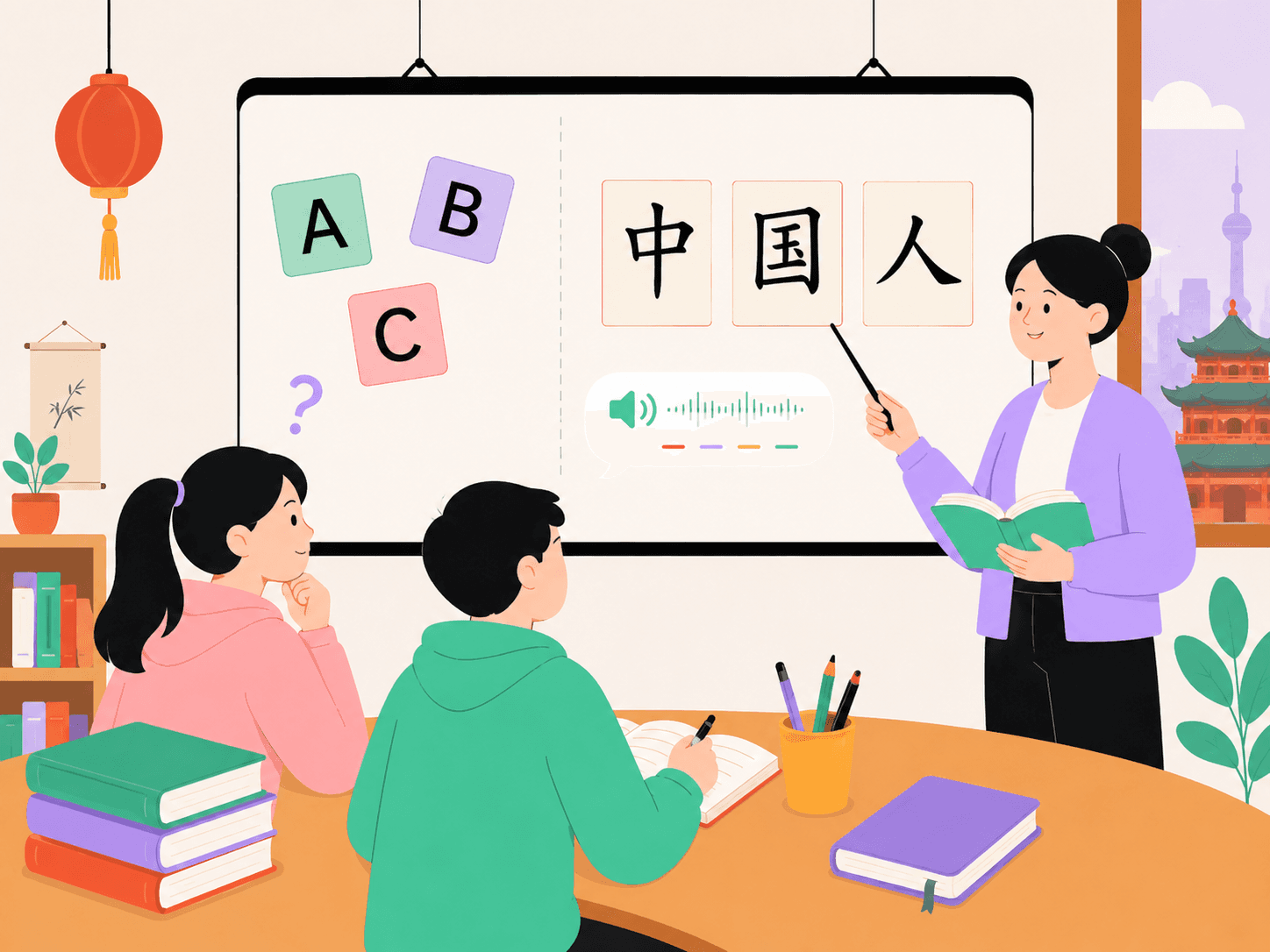
Does Chinese have an alphabet?
The short answer is: no, Chinese does not use an alphabet as its main writing system.
In Russian, we have letters: а, б, в, г.
In English: a, b, c, d.
But in Chinese, instead of letters, people use characters — separate written signs.
人
rén
person
水
shuǐ
water
书
shū
book
好
hǎo
good / well
Each character usually represents not a single sound, like a letter, but a syllable and a meaning.
What are Chinese characters?
A Chinese character is a written sign that can represent a word or part of a word.
火
huǒ
fire
山
shān
mountain
日
rì
sun / day
Many Chinese words consist of one or two characters:
书
shū
book
学生
xuésheng
student
中国
Zhōngguó
China
咖啡
kāfēi
coffee
So Chinese words are not built from letters like in Russian or English. They are written with characters, and each character needs to be recognized and remembered.
Then how do you know how to read a character?
For this, there is pinyin.
Pinyin is a system for writing the pronunciation of Chinese words using Latin letters and tone marks.
你
nǐ
you
好
hǎo
good / well
中国
Zhōngguó
China
谢谢
xièxie
thank you
Pinyin helps students understand how a character is pronounced, but it does not fully replace Chinese writing. In regular Chinese texts, books, menus, messages, and signs, you will see characters, not pinyin.
Is pinyin an alphabet?
Pinyin looks like an alphabet because it uses Latin letters: a, o, e, i, u, ü, b, p, m, f, and others.
But it is important to understand: pinyin is not the Chinese alphabet, but a transcription system.
It is used to:
For example, to type 你好, you can enter nihao on the keyboard and then choose the correct characters.
What does a Chinese syllable consist of?
A Chinese syllable usually consists of three parts:
initial + final + tone
mā
mom
Here:
m — the initial, the starting consonant sound;
a — the final, the main part of the syllable;
the first tone — a high, level tone.
hǎo
good / well
shū
book
lǎoshī
teacher
In Chinese, it is very important not only to pronounce the sounds correctly, but also to use the right tone. The same syllable with different tones can have different meanings.
mā
mom
má
hemp
mǎ
horse
mà
to scold
That is why pinyin helps you not just “read a word,” but immediately see its pronunciation and tone.
Why you should not learn Chinese only through pinyin
At the beginning, pinyin is very useful. It helps you start reading words, pronouncing phrases, and getting used to new sounds more quickly.
But if you study Chinese only through pinyin, difficulties will appear quite soon.
First, many Chinese words sound the same or very similar, but are written with different characters.
shū can appear in different words and meanings:
书
shū
book
输
shū
to lose
Second, without characters, it is difficult to read real texts, menus, signs, and messages.
That is why it is better to get used to this combination from the very beginning:
character + pinyin + translation
水
shuǐ
water
茶
chá
tea
饭
fàn
food / rice
This way, Chinese gradually becomes clearer both visually and by ear.
Do you need to learn all characters at once?
No. One common beginner mistake is thinking that you first need to learn a huge number of characters and only then start speaking.
In reality, it is better to move step by step:
我
wǒ
I / me
你
nǐ
you
好
hǎo
good / well
我是学生。
wǒ shì xuésheng.
I am a student.
This way, you do not just memorize separate signs — you immediately see how they work in speech.
How do Chinese children learn to read?
Chinese children also do not start with an “alphabet” in the usual sense. They gradually learn characters, pronunciation, reading, and writing.
Pinyin is used in education to help with pronunciation, but the main writing system still remains character-based.
For foreigners, pinyin is a convenient bridge between familiar letters and Chinese characters.
The main idea
Chinese does not have an alphabet in the usual sense. Chinese writing is based on characters, and pinyin is used to write pronunciation.
Pinyin helps you understand how a word is read, but it does not replace characters. That is why, when learning Chinese, it is important to gradually get used to both systems: seeing the character, knowing its pronunciation, and understanding its meaning.
- show the pronunciation of a character;
- learn how to read new words;
- pronounce sounds and tones correctly;
- type Chinese text on a phone or computer.
- first learn the basic sounds and tones;
- get familiar with pinyin;
- start reading simple words;
- gradually add characters;
- make short phrases and sentences.